If you love talking about the weather, you’re not alone! Weather is an essential part of daily life and a universal conversation starter. Whether you’re making small talk, planning your day, or just curious about different climates, learning weather-related phrases in Chinese can be incredibly useful.
Even if discussing the weather isn’t your go-to topic, knowing how to describe it in Chinese will help you feel more natural in conversations.
And who knows? You might end up having a fun chat about a sudden downpour or an unusually sunny day!
In this post, we’ll introduce four common Chinese phrases related to rain and snow, all built around one key character: 下 (xià).
To descend/to fall down 下
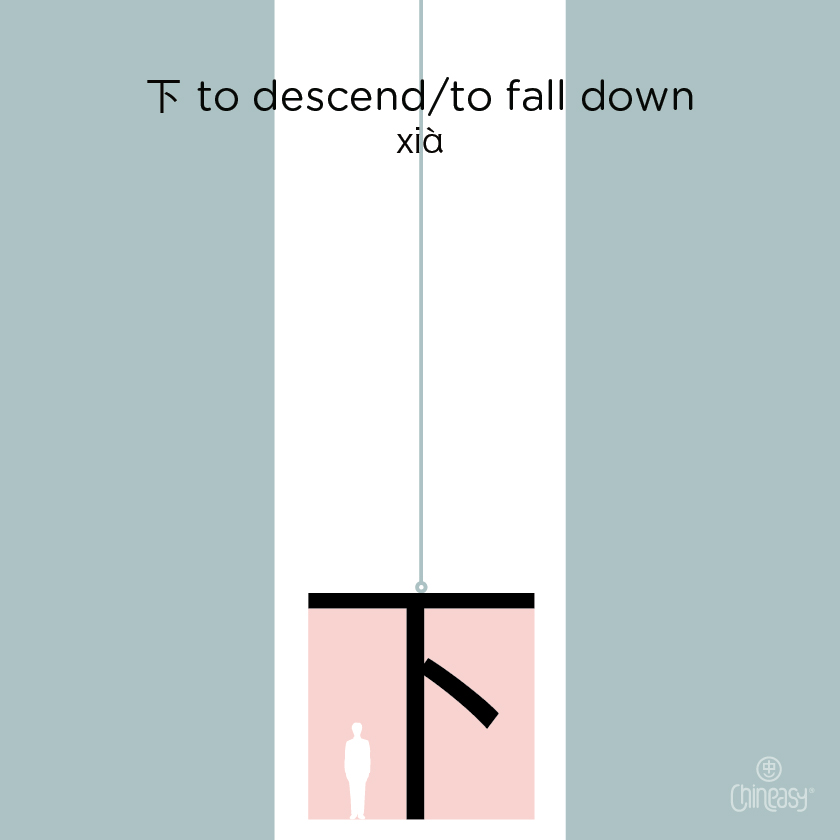
The character下 (xià) originally resembled an upside-down 二 (èr; two) in its ancient form, symbolizing something moving downward.
Today, 下 is commonly used as a verb meaning “to descend, lower, fall down,” or “get off.”
In weather-related expressions, 下 describes natural elements like rain and snow falling from the sky.
To rain 下雨
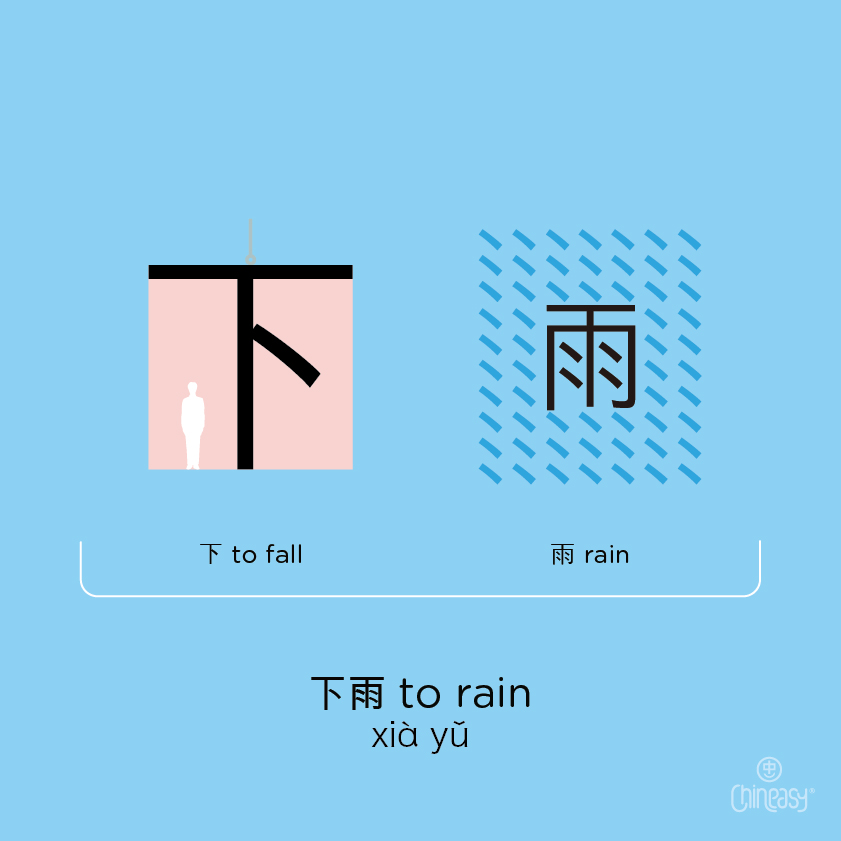
下 (to descend/fall down) + 雨 (rain) = 下雨 (to rain)
In Chinese, rain is described as something falling down from the sky, which is why we say 下雨 (xià yǔ) rather than using a separate verb for “to rain.” The structure is logical and follows the same pattern for other types of precipitation.
Example Sentence:
下雨了。
Xià yǔ le
It’s raining (now).
📌 Grammar Explanation: 了 (le) in 下雨了
In 下雨了, the particle 了 (le) is used to indicate a change of state. This means that it wasn’t raining before, but now it is.
Unlike in English, where we might just say “It’s raining,” Chinese often uses 了 to emphasize that a situation has recently changed. Without 了, 下雨 (xià yǔ) simply means “to rain,” but adding 了 makes it clear that the rain has just started or that the weather has changed.
📌 Key takeaway:
下雨 (xià yǔ) → Describes the action of raining in general.
下雨了 (xià yǔ le) → Means “It’s raining now” or “It has started raining.
Cultural Insight:
China experiences a wide range of climates, from the humid monsoons in the south to the dry northern plains. In many regions, especially during spring and summer, people often carry an umbrella (雨傘/雨伞; yǔ sǎn) not just for rain but also to shield themselves from the sun.
Rain heavily 下大雨
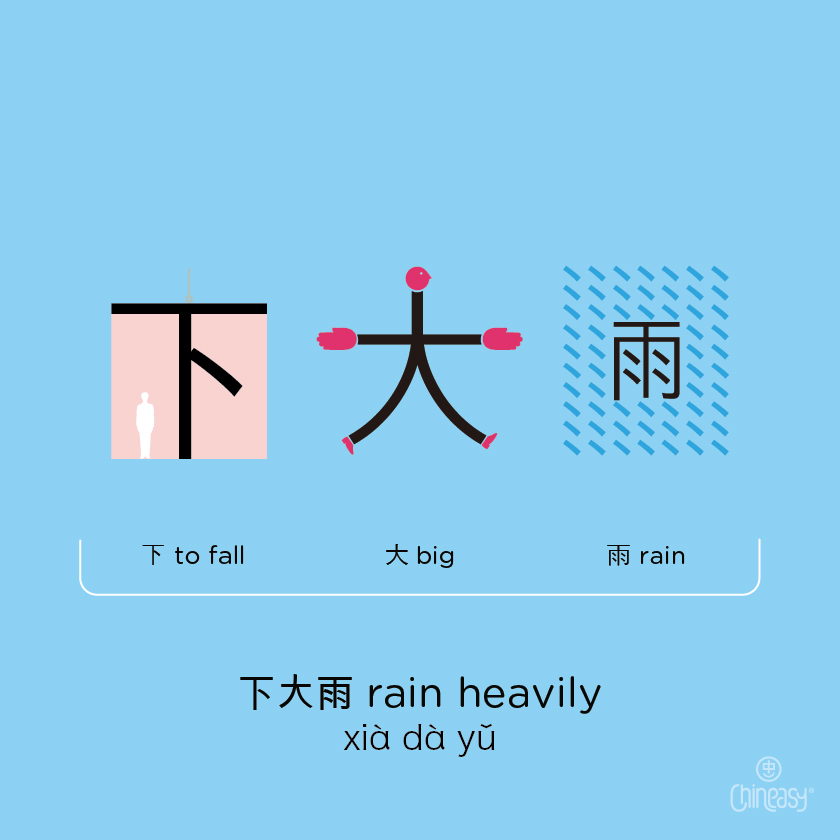
下 (to fall down) + 大雨 (heavy rain) = 下大雨 (to rain heavily)
When adding 大 (dà; big) before 雨 (yǔ, rain), the phrase intensifies to mean “heavy rain” or “downpour.” If you’re caught in a sudden rainstorm, this is the phrase you’ll need!
Example Sentence:
外面下大雨了。
Wàimiàn xià dà yǔ
It’s raining heavily outside.
📌 Grammar Explanation: Location Words at the Beginning
In 外面下大雨了, the location word 外面 (wàimiàn; outside) appears at the beginning because Chinese follows a place-before-action word order:
📌 Key takeaway:
•外面下大雨了 (Wàimiàn xià dà yǔ le) → “Outside, it’s raining heavily now.” (Starts with the place, then describes the rain.)
•下大雨了外面 (Xià dà yǔ le wàimiàn) → ❌ This word order sounds unnatural in Chinese.
Nature Insight:
One of the most famous rainy destinations in China is Chongqing (重慶/重庆; chóng qìng), often called the “Fog City” due to its constant mist and drizzles. If you visit during the rainy season, be prepared for extended showers!
To snow 下雪
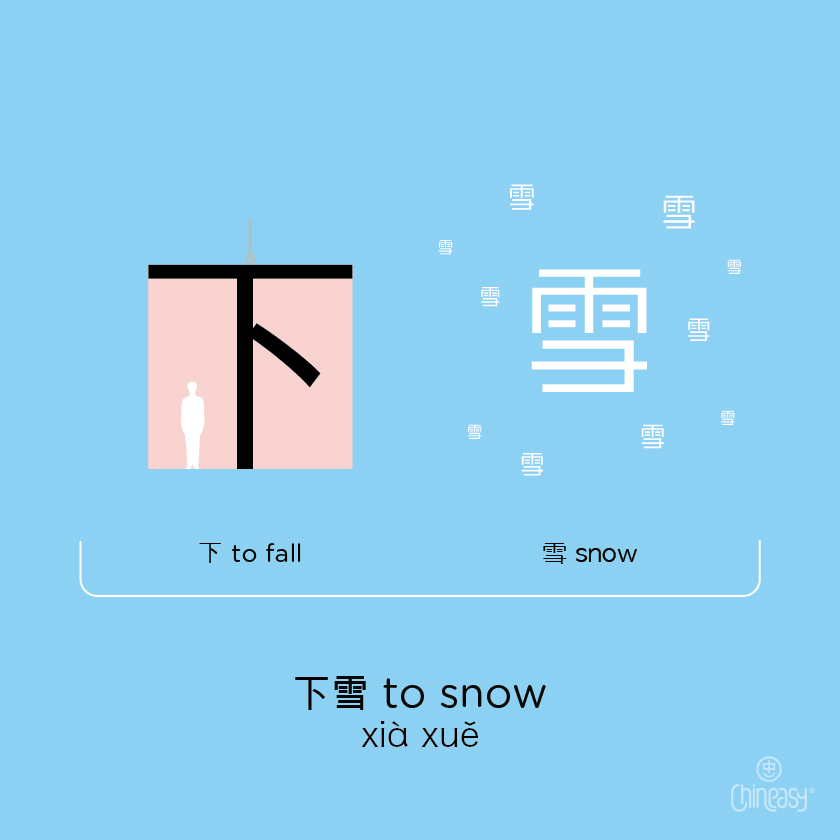
下 (to fall down) + 雪 (snow) = 下雪 (to snow)
Just like rain, snow in Chinese is described as falling down from the sky. That’s why we say 下雪 (xià xuě) instead of using a separate verb like in English.
Example Sentence:
明天會下雪嗎?(Traditional Chinese)
明天会下雪吗?(Simplified Chinese)
Míngtiān huì xià xuě ma
Will it snow tomorrow?
📌 Grammar Explanation: 會/会 for Future Events or Possibility
In 明天會下雪嗎/明天会下雪吗, the word 會/会 (huì) is used to indicate a future event or possibility.
📌 会 can express:
•Future certainty → “will” (when something is expected to happen)
•Likelihood → “might” or “is likely to” (when something is probable but not guaranteed)
In this question, 明天會下雪嗎/明天会下雪吗 asks if snowfall is expected or likely tomorrow, making 会 a useful word when discussing future weather predictions.
Nature Insight:
Snowfall varies across China. The northern regions, such as Harbin (哈爾濱/哈尔滨; hā ěr bīn), experience harsh winters with thick snow, while cities like Shanghai (上海; shàng hǎi) rarely see more than a light dusting.
It snows every day 天天下雪

天天 (every day) + 下雪 (to snow) = 天天下雪 (snows every day)
If you want to emphasize frequent snowfall, you can use 天天 (tiāntiān), meaning “every day.” This phrase is useful when describing places where snow is a daily occurrence.
Example Sentence:
哈爾濱冬天天天下雪。(Traditional Chinese)
哈尔滨冬天天天下雪。(Simplified Chinese)
Hāěrbīn dōngtiān tiāntiān xià xuě.
It snows every day in Harbin in winter.
Did you know?
Japan is considered one of the snowiest places on Earth! Some areas, especially along the western coast, receive more annual snowfall than even parts of Siberia or Canada.
Final Thoughts
Weather-related phrases are not only practical but also a great way to start conversations in Chinese. Saying 下雨了 (It’s raining) or 下雪了 (It’s snowing) helps you describe the world around you more naturally.
So next time you step outside and see rain or snow, try saying it in Chinese. Who knows? It might just be the perfect icebreaker for your next conversation!